Receptionist · 7 min read
How does missed-call text back work, and what rules apply to a small business?
Short answerMissed-call text back is an automatic text sent to a caller, usually within a minute, when nobody answers your business line. It is a low-cost first step, and several phone apps include it. The rules matter: the FCC's order adopted on September 30, 2026 says text senders must honor opt-out replies such as STOP, QUIT or UNSUBSCRIBE within ten business days at most, and carriers expect registration for business texts from a standard local number. A text that only helps the caller is treated differently from a promotion, so keep the auto-reply helpful and short, and have a lawyer review your setup.

What is missed-call text back, and how does it work?
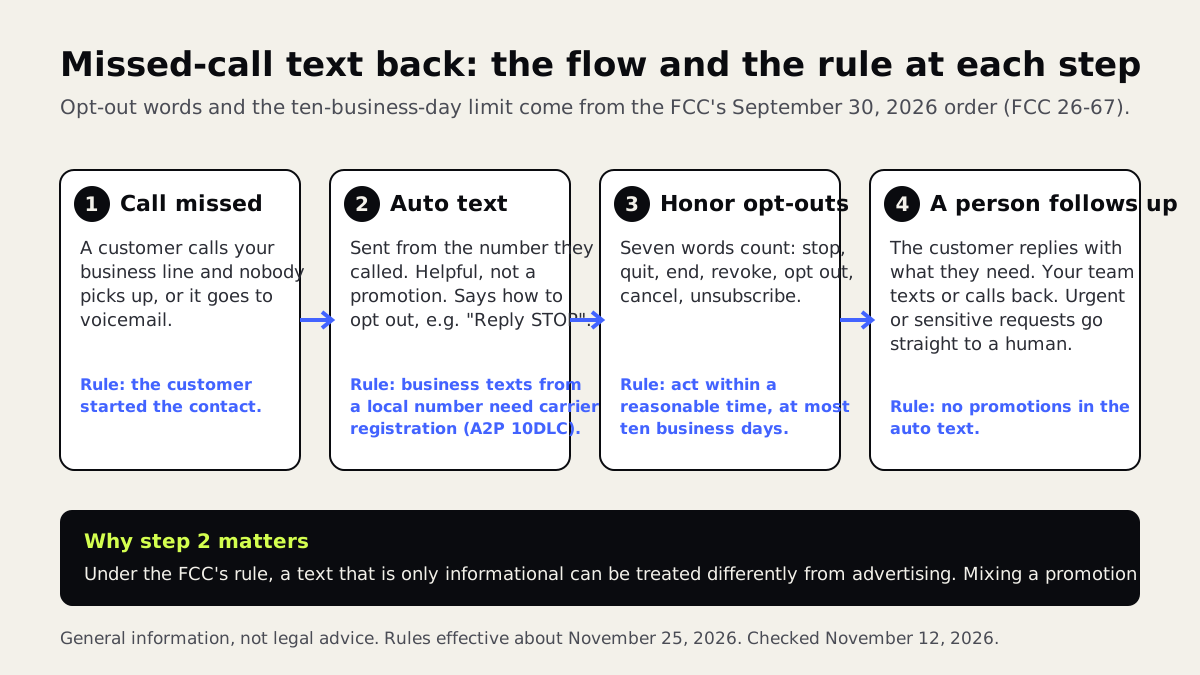
A customer calls your business number and nobody picks up. Within about a minute, your phone system sends a text from the same number: "Sorry we missed you. How can we help?" The customer replies, and someone on your team continues by text or calls back.
It is the cheapest way to close part of the gap we described in our missed calls guide. It does not answer the call. It gives the caller a reason to stay, and it gives you a written note of what they wanted. Speed matters here for the same reasons covered in our piece on lead response time.
It works best from the number the customer actually called. A text from an unfamiliar number looks like spam, and many phone apps are built to send the reply from your business line.
Is it legal? What the FCC's 2026 rule says
We are not lawyers, and this is general information, not legal advice. The rules changed recently, so here is what the official notice says.
The FCC adopted a final rule on September 30, 2026 (order FCC 26-67). The Federal Register notice lists these points:
- Two categories of messages. For calls and texts that are purely informational, a sender may treat an opt-out as applying only to that category. For advertising or telemarketing texts, an opt-out applies to all future advertising or telemarketing from that sender.
- Opt-out words. A sender can designate replying with a standard word as its opt-out method: stop, quit, end, revoke, opt out, cancel or unsubscribe. The text has to say how to opt out, and including one word such as "stop" is enough. The sender must still honor any of the seven.
- Timing. Opt-outs must be honored within a reasonable time, not more than ten business days after the request arrives.
- Start date. The rule takes effect 30 days after Federal Register publication, which the notice puts at about November 25, 2026. A law-firm alert dated October 27, 2026 also gives November 25. The FCC is still taking comments on further changes, so check again before you rely on the details.
What does that mean for an auto-reply? A text that only answers a customer who just called you is generally treated as informational. A text that adds a coupon or an offer is advertising, and advertising has stricter consent rules. The simple habit that protects you: keep the missed-call text helpful, short, free of promotions, and always honor a STOP.
What do the mobile carriers require?
Separate from the FCC, US carriers expect businesses that send texts through software from a standard 10-digit local number to register. This system is called A2P 10DLC. Twilio's documentation explains it plainly:
- You register a brand (who you are), then a campaign (how people opt in, opt out and get help, and what the messages are for).
- Twilio says unregistered traffic on 10DLC numbers can bring extra carrier fees, and registered traffic faces less filtering.
- Its sole-proprietor brand type allows one campaign and about 1,000 message segments a day to T-Mobile (about 3,000 across US carriers). Larger brand types need a tax ID.
Many phone apps handle part of this for you, but check. Ask the vendor in writing whether registration is included, what it costs, and who is responsible if messages get blocked.
What does it cost?
Several small-business phone apps include a missed-call auto-reply, so you may already own the feature. Quo's pricing page (checked November 12, 2026) shows three plans, each priced per user per month:
| Quo plan | Billed monthly | Billed annually |
|---|---|---|
| Starter | $19 | $15 |
| Business | $33 | $23 |
| Scale | $47 | $35 |
Its comparison table lists automatic replies to texts, missed calls and voicemails as included on all three. Other field-service and CRM tools offer similar settings, so check what your current software already does before buying anything. Prices and features change, and your carrier and registration costs are separate.
When is an AI receptionist the better fit?
Text back is a patch. It starts a conversation after the customer has already hung up. An AI receptionist answers the call itself, takes the details, books routine requests and hands real emergencies to a person.
| Missed-call text back | AI receptionist | |
|---|---|---|
| What it does | Texts the caller after the missed call | Answers the call and collects details |
| Caller experience | Waits for a reply | Gets an answer in the moment |
| Best for | Low call volume, simple follow-up | Frequent calls, after hours, booking |
| Main risk | Message rules and blocked texts | Wrong answers, so it needs approved facts and a human handoff |
If most of your missed calls come after hours, compare a live answering service as well. Our after-hours comparison and our guide to AI receptionist costs put real prices side by side. For many small businesses the sensible order is: turn on the free auto-reply you already have, count what it recovers for a month, then decide whether to add a receptionist.
What should you do this week?
- Check what you already own. Open your phone app or CRM settings and look for "missed call" or "auto-reply."
- Write a short, helpful text. Name your business, ask how you can help, and add one opt-out line such as "Reply STOP to opt out." Leave out offers and discounts.
- Test your STOP. Text STOP, QUIT and UNSUBSCRIBE to your own line and confirm each one actually stops messages.
- Ask about registration. Get the vendor's answer on 10DLC in writing.
- Track it for 30 days. Count missed calls, replies and booked jobs. Use your own numbers to decide what to add next.
- Have a lawyer review the wording before you scale it.
If you would rather have it built and tested for you, our AI receptionist service sets up approved answers and the human handoff, and our business process automation work connects missed calls to your CRM and follow-up. To talk it through, book a free AI strategy call.
Frequently asked questions
Is missed-call text back legal?
It is commonly used, but it falls under federal and carrier texting rules. A text that only responds to a customer's own call is generally informational, and one that adds a promotion is advertising, which has stricter consent rules. We are not lawyers, so have a lawyer review your wording and setup.
What words must I honor as opt-outs?
Under the FCC order adopted on September 30, 2026, senders must honor stop, quit, end, revoke, opt out, cancel and unsubscribe, and process the request within a reasonable time, not more than ten business days. The rule takes effect about November 25, 2026, and further changes are being considered.
Do I need to register my business to send these texts?
If you send texts through software from a standard 10-digit local number, US carriers expect A2P 10DLC registration, as Twilio's documentation describes. Many phone apps handle part of this, so ask your vendor in writing what is included.
Sources
- Federal Register notice — public-inspection.federalregister.gov
- law-firm alert dated October 27, 2026 — www.bhfs.com
- documentation — www.twilio.com
- pricing page — www.quo.com
Written and reviewed by the INTELVYRA team. Prices and figures were checked on the date above and can change. Always confirm current pricing with each provider.