Industries · 7 min read
Should an HVAC company use an AI receptionist, and how do you set one up safely?
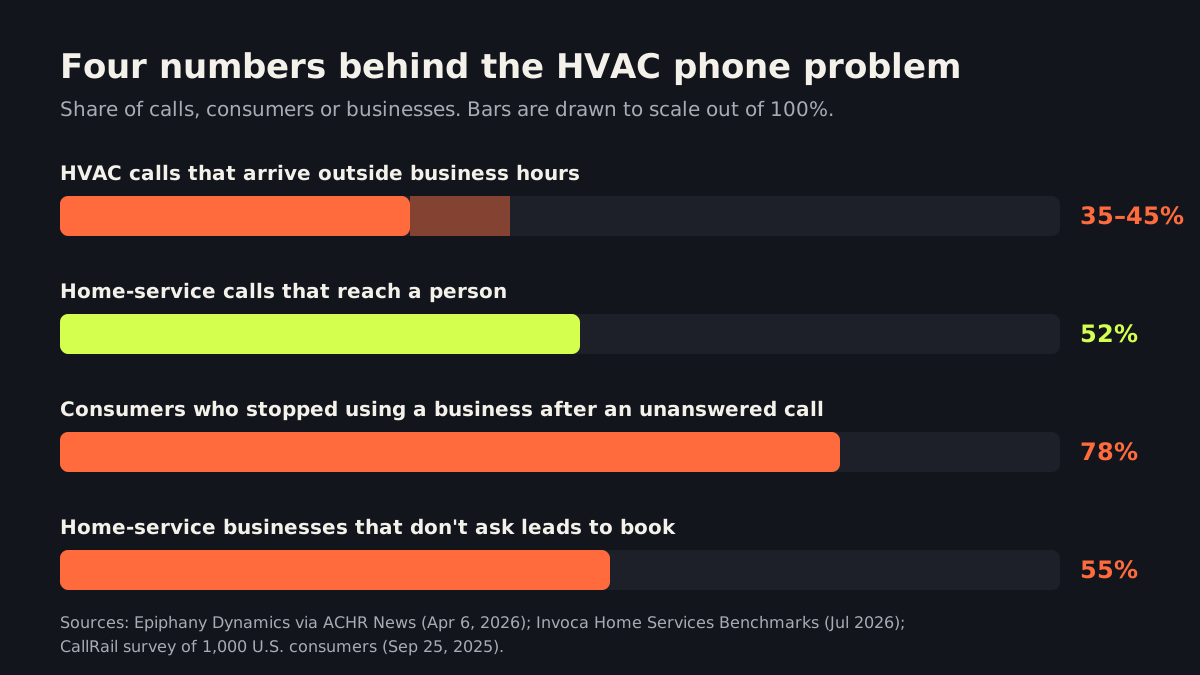
Short answerYes, for most HVAC companies an AI receptionist is worth testing, as long as it answers and books the routine calls and passes every emergency to a person. Invoca's July 2026 benchmark found that only 52% of calls to home-service businesses reach a person, and trade data reported by ACHR News puts 35–45% of HVAC calls outside business hours. Start with after-hours and overflow calls, write clear emergency rules (gas smell, no heat, carbon monoxide alarm), connect it to your scheduling software, and review recordings every week for the first month.
Why do HVAC companies miss so many calls?
Because the phone rings hardest exactly when everyone is busy. The U.S. Bureau of Labor Statistics (page updated October 29, 2026) notes that HVAC technicians may be on call for emergencies and often work overtime or irregular hours during peak heating and cooling seasons. The first cold snap of November brings a wave of "no heat" calls at the same moment your techs are already on jobs and your office is buried.
The numbers back this up. Invoca's 2026 Home Services Lead Conversion Benchmarks Report (July 2026), drawn from anonymized calls across HVAC, plumbing and seven other trades, found that just 52% of inbound calls reach a person. For calls longer than 15 seconds, which filters out most hang-ups and wrong numbers, it is still only 65%.
Timing makes it worse. In an ACHR News report (April 6, 2026), workflow-software designer Epiphany Dynamics estimates that 35–45% of HVAC calls come in before 8 a.m., after 5 p.m., on weekends or on holidays. That is a big share of your demand arriving when nobody is at the desk.
And hiring your way out is hard. BLS counts 440,900 HVAC mechanic and installer jobs in 2025 and projects 11% growth through 2035, much faster than average, with about 40,600 openings a year. Every skilled person you have is better used on a job than on hold music.
What does a missed HVAC call actually cost?
Most callers will not wait for you. In a CallRail survey of 1,000 U.S. consumers (September 25, 2025), 78% said they had stopped doing business with a company after an unanswered call, 21% said they immediately call another business, and only 42% leave a voicemail. Holding is not much better: 41% hang up after one or two minutes on hold.
The calls that do get answered are valuable. Invoca's lead conversion benchmarks (August 21, 2026) show that 38% of answered home-service calls are real leads and 45% of those leads convert on the call. Yet the same report found that 55% of home-service businesses don't ask the caller to book the job. So the problem is twofold: calls that never reach anyone, and calls that reach someone who doesn't close.
We are not going to give you a magic "lost revenue" figure, because it depends on your average ticket, close rate and season. Do the math with your own numbers instead: missed calls per week, times the share that are real jobs, times your average job value. Our guide to missed calls in small businesses walks through how to count them.
What can an AI receptionist do for an HVAC company?
Think of it as the triage desk at an emergency room. Everyone who walks in is greeted right away. Most people get their details taken and a time slot. But the person clutching their chest is not asked to fill out a form; they are rushed straight to a doctor. A good AI receptionist works the same way: every caller gets an instant answer, routine requests get booked, and anything dangerous goes straight to a human.
In practice, the routine work looks like this:
- Answering 24/7 and in overflow. Nights, weekends and the Monday after a heat wave, with no voicemail.
- Booking and rescheduling. When it is connected to your field-service software, it can put jobs on the real schedule. ServiceTitan, for example, says (March 6, 2026) its virtual agent books directly to the dispatch board and recognizes existing customers.
- Collecting job details. Address, equipment type, symptoms, maintenance-plan status and the best callback number, written into your CRM instead of on a sticky note.
- Outbound reminders. Maintenance tune-up reminders and appointment confirmations, which a June 7, 2026 ACHR News column by the CEO of a voice AI vendor lists among the common uses.
Customers are more open to this than many owners expect. In the CallRail survey, 52% said companies that use AI assistants after hours provide superior service.
How should it handle gas leaks, no-heat calls and other emergencies?
This is the part you cannot leave to the vendor's defaults. Write the rules yourself, in plain language, before anything goes live:
- Gas smell or a carbon monoxide alarm: safety first, then a person. The AI should not troubleshoot. It should repeat official advice and stop. The Consumer Product Safety Commission (March 16, 2026) says to leave the home immediately if you smell gas and contact the gas authorities from outside, and to get outside and call 911 if a CO alarm sounds. Then alert your on-call tech.
- No heat or no cooling with vulnerable people at home: transfer live to the on-call dispatcher, or text and call them at once if no one picks up.
- Water leaks, burning smells, breakers tripping: treat as urgent and escalate.
- Everything else (tune-ups, quotes, filter questions): book or take a message.
ServiceTitan describes the same pattern: its agent routes urgent calls such as no heat, gas smells and water leaks to the on-call dispatcher and passes context to a live CSR so the caller doesn't repeat themselves. The ACHR News column adds two warnings worth taking seriously: always keep a human supervisor available, and don't build a loop that sends the caller back to the same busy staff who could not answer in the first place.
Which setup fits your HVAC company?
| Your situation | Good starting point |
|---|---|
| Owner-operator, 1–3 trucks, phone in your pocket | AI answers after hours and when you are on a job, takes details, texts you urgent calls |
| Office staff during the day, nobody at night | Staff by day, AI after hours and for overflow, with live transfer to the on-call tech |
| Already on ServiceTitan, Housecall Pro or similar | An AI receptionist connected to that schedule so bookings land on the real dispatch board |
| Lots of commercial or complex jobs | AI for intake and booking estimates; quotes and diagnosis stay with people |
If you are comparing AI against a live answering service for nights, our article on after-hours answering services vs AI receptionists lays out the trade-offs, and our AI receptionist cost guide covers typical monthly prices.
What should you do this week?
- Count your misses. Pull last month's call log from your phone system and note how many calls went unanswered, and how many came after 5 p.m. or on weekends.
- Write a one-page emergency sheet. List what counts as an emergency, who is on call, and exactly what the caller should be told. This is useful even if you never buy AI.
- Start small. ACHR News's "crawl, walk, run" advice applies: begin with after-hours calls and web form leads, not your whole phone line.
- Insist on integration and recordings. Bookings should land in your scheduling software, and you should be able to listen to every call.
- Review weekly for a month. Listen to a sample of calls, fix wrong answers, and track booked jobs from calls that would have gone to voicemail.
This is the kind of work our AI receptionist service is built for: we write the call rules with you, connect the system to your schedule and CRM through lead capture and CRM automation, and set up live handoff for emergencies. If you want to know whether it makes sense for your shop before the winter rush, book a free AI strategy call.
Frequently asked questions
Can an AI receptionist book HVAC jobs directly into my schedule?
Yes, when it is connected to your field-service or scheduling software. ServiceTitan, for example, says its virtual agent books directly to the dispatch board. Without that connection, it can still take details and send them to your team to confirm.
What should an AI receptionist do if a caller smells gas?
It should not troubleshoot. It should tell the caller to leave the home right away and contact the gas utility or 911 from outside, in line with Consumer Product Safety Commission advice, and then alert your on-call technician immediately.
Will customers hang up on an AI receptionist?
Some will, but many prefer it to voicemail. In a 2025 CallRail survey of 1,000 U.S. consumers, only 42% said they leave a voicemail when a business does not answer, and 52% said companies using AI assistants after hours provide superior service.
Sources
- U.S. Bureau of Labor Statistics — www.bls.gov
- 2026 Home Services Lead Conversion Benchmarks Report — invoca.com
- ACHR News report — www.achrnews.com
- CallRail survey — www.callrail.com
- lead conversion benchmarks — www.invoca.com
- says — www.servicetitan.com
- June 7, 2026 ACHR News column — www.achrnews.com
- Consumer Product Safety Commission — www.cpsc.gov
Written and reviewed by the INTELVYRA team. Prices and figures were checked on the date above and can change. Always confirm current pricing with each provider.