Receptionist · 7 min read
How many customers does a small business lose to missed calls?
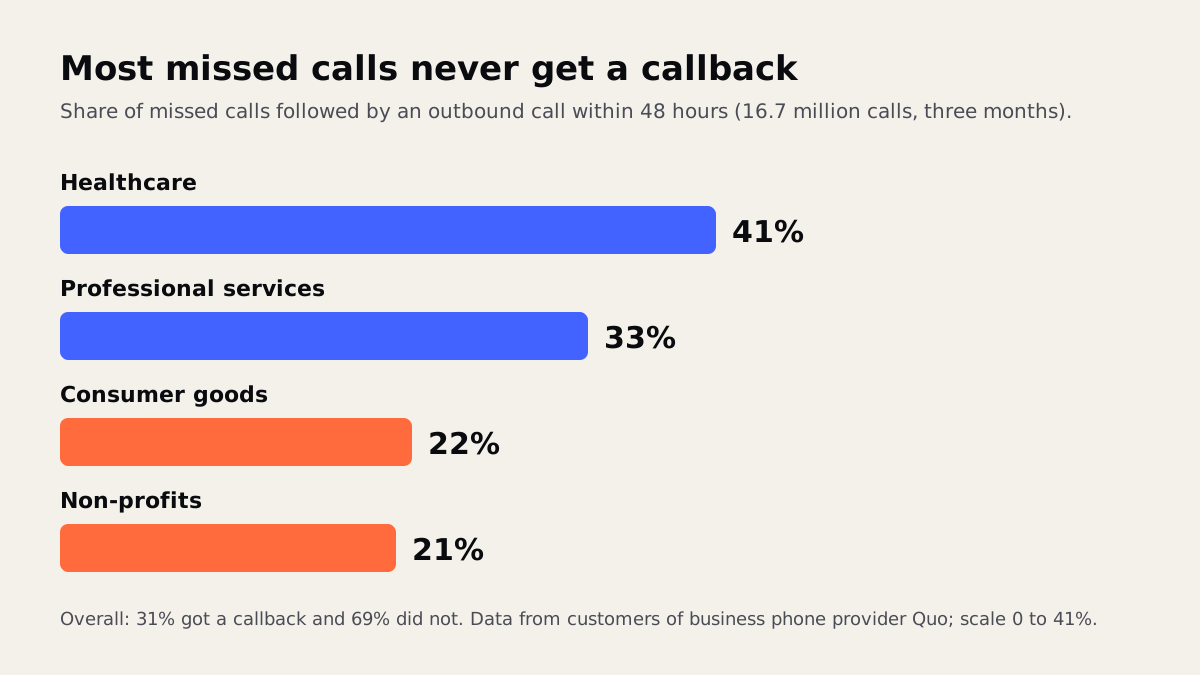
Short answerMissed calls cost small businesses real customers because most callers do not wait. In a CallRail survey of 1,000 US consumers, 78% said they had abandoned a business after an unanswered call, and a Quo analysis of 16.7 million missed calls found that 69% never got a callback within 48 hours. The fix is a mix of coverage (someone or something answers every call), fast follow-up, and a clear handoff to a person for anything urgent or sensitive.

How many missed calls really turn into lost customers?
Think of an unanswered phone as a locked front door with a competitor's open door across the street. Some people will wait or come back. Most will walk across.
Two recent data sets show how that plays out. CallRail surveyed 1,000 US consumers and published the results on September 25, 2025. 78% said they had abandoned a business after an unanswered call, 82% said they would call a competitor if nobody picked up, and 21% would call another business immediately. Only 42% would leave a voicemail, and 24% would try online chat instead (CallRail, September 25, 2025).
The second data set looks at what businesses do afterward. Quo, a business phone provider, analyzed 16.7 million missed calls from its own customers over three months. 69% of missed calls received no callback within 48 hours, and nearly every callback that did happen came within the first day. Only about 15% of callers left a voicemail (Quo, published August 20, 2026, updated November 2, 2026).
Both sources come from companies in the business-phone space, so read the numbers as strong signals, not laboratory facts. CallRail does not publish its survey dates or question wording, and Quo's data covers its own customers. They still agree on the direction: people rarely wait, and businesses rarely call back.
Why do small businesses miss calls in the first place?
It is almost never carelessness. The usual causes are ordinary:
- You are working. A plumber under a sink, a dentist with a patient in the chair and a stylist with scissors in hand cannot answer a phone.
- Calls bunch up. Mondays, lunch hours and the first hour after you open produce overlapping calls, and the second caller hears ringing.
- After hours. Many people search and call in the evening or on weekends, when no one is there.
- Voicemail is a dead end. Few callers leave a message, and messages that do arrive can sit unheard for a day.
- Nobody owns the callback list. The missed call shows on someone's phone, then gets buried.
Notice that the last two are follow-up problems, not answering problems. Even a business that answers most calls can lose customers if the ones it missed are never returned. We cover the same pattern for web forms in our guide to lead response time.
What does a missed call cost you?
The honest answer is: it depends on your numbers, and published averages will not match your business. Do this instead:
- Open your phone's call log and count the missed or unreturned calls from last week.
- Estimate how many were new customers rather than suppliers, spam or existing clients.
- Estimate what share of new-customer calls normally becomes a paying job.
- Multiply by your average job or order value.
Illustrative example, not a benchmark: 12 missed new-customer calls a week, 1 in 4 normally booking, at a $250 average job, is about $750 a week in work that went elsewhere. Your own count might be far smaller. If it is, you may not need new tools, just a better callback habit.
What are your options for stopping missed calls?
| Option | Works well for | Watch out for |
|---|---|---|
| Better voicemail and a callback routine | Low call volume, an owner who can return calls within the hour | Depends entirely on discipline; most callers hang up before the beep |
| Staff or shared inbox rotation | Businesses with a front desk in business hours | Does not cover after hours or busy peaks |
| Human answering service | Callers who want a live person, 24/7 | Priced per minute or per call; scripts can feel generic |
| AI receptionist | After-hours and overflow calls, booking, common questions | Needs approved answers and a clear handoff to a human |
| Automatic follow-up (text or email after a missed call) | Capturing the caller before they search for the next business | Consent and opt-out rules apply; keep messages short and honest |
These are not either-or. Many small businesses answer in person during the day and let an AI receptionist pick up the overflow and the evenings. For current price ranges, see what an AI receptionist costs. Callers are not uniformly hostile to this either: in the CallRail survey, 52% said they think businesses that use AI assistants after hours give better service, and 50% would use AI to book an appointment (CallRail, September 25, 2025). Treat that as one vendor's survey, but it suggests an honest AI voice is more acceptable than a ringing phone.
What should an AI receptionist do, and what should it never do?
Done well, it does a short list of things reliably: greet the caller, answer from information you approved (hours, service area, general pricing), book or request an appointment, take a detailed message, and send you a summary. It should hand off to a person for emergencies, complaints, health or legal questions, and anything it does not know. It should never invent a price, promise a time slot you cannot meet or give advice it was not given.
One legal point is worth knowing. On February 8, 2024, the FCC announced a unanimous ruling that calls made with AI-generated voices count as "artificial" under the Telephone Consumer Protection Act, which puts them under the same prior-consent rules as other robocalls (FCC, February 8, 2024). That ruling is about outbound calling. Answering a customer who phoned you is a different situation, but if you plan to have an AI place calls or send automated follow-ups, get written consent rules checked by a lawyer first. We are not lawyers, and this is not legal advice.
What should you do this week?
- Count. Pull last week's call log and list every missed or unreturned call.
- Set a callback rule. For example: every missed call gets a response within 30 minutes during business hours, and a first-thing-in-the-morning reply after hours. Write it down and name one person who owns it.
- Fix your voicemail. Say when you will call back and offer a text or web-form option. Keep it under 20 seconds.
- Test yourself. Call your own number at 7 p.m. from a different phone and note what a stranger experiences.
- Connect the follow-up. Send missed-call details into one place, such as a spreadsheet or CRM, so nothing disappears. Our lead capture and CRM automation work does exactly that, and which business tasks to automate first shows where to start.
- Decide on coverage. If the test shows you are still missing calls after the first four steps, price an AI receptionist or answering service against the weekly number you calculated above.
If you want a second pair of eyes on your call flow, book a free AI strategy call and we will map where calls are slipping and what is worth fixing first.
Frequently asked questions
Why do customers hang up instead of leaving a voicemail?
Because they have alternatives. In Quo's analysis of 16.7 million missed calls, only about 15% of callers left a voicemail, and in CallRail's survey of 1,000 US consumers, 82% said they would call a competitor if nobody answered.
How quickly should I return a missed call?
As fast as you reasonably can. Quo's data shows that nearly all callbacks that happen occur within 24 hours, and most missed calls get none. A written rule, such as within 30 minutes during business hours, beats good intentions.
Is an AI receptionist the only way to stop missing calls?
No. A callback routine, a shared inbox, a human answering service and automatic follow-up all help. An AI receptionist is most useful for after-hours and overflow calls, as long as it uses approved answers and hands urgent or sensitive calls to a person.
Sources
Written and reviewed by the INTELVYRA team. Prices and figures were checked on the date above and can change. Always confirm current pricing with each provider.