Industries · 7 min read
How should an independent insurance agency start using AI?
Short answerStart with the slow, repetitive work around the client, not the advice itself: answering calls and web inquiries fast, following up on quotes, renewal reminders, collecting documents and summarizing notes into your management system. Keep a licensed person on every coverage decision. Clients are ready for this: in a September 2026 Big "I" survey, 61% said they are more likely to choose an agent who uses AI for faster service, while 87% said a human agent still matters.

Where are independent agencies with AI right now?
Interest is high, but most agencies are still testing. The Agents Council for Technology (ACT), part of the Big “I,” found that 68% of independent agencies were likely to increase their AI use over the next 12 months, yet only 8% had AI built into daily workflows. About 31% were not using it at all and 33% were “just experimenting” (Insurance Journal, March 9, 2026).
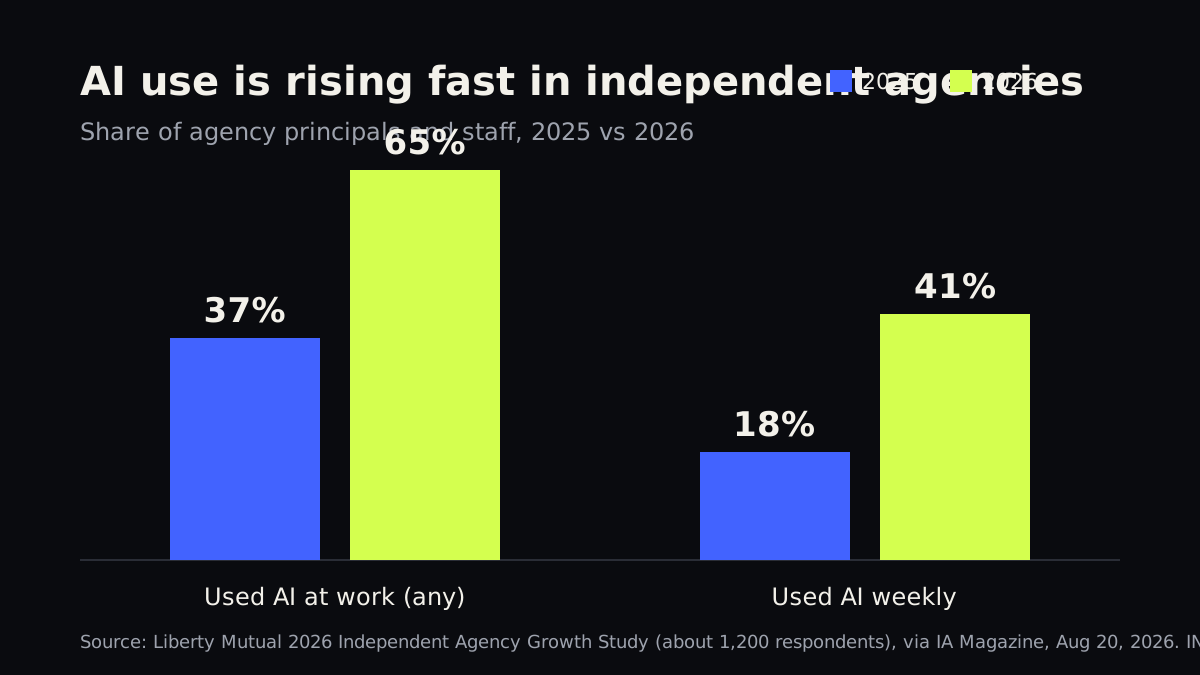
Use is climbing fast at the individual level. Liberty Mutual's 2026 Independent Agency Growth Study surveyed nearly 1,200 agency principals and staff. It found 65% had used AI at work at least a few times in the past year, up from 37% in 2025, and weekly use rose from 18% to 41%. AI users estimated they save about 4 hours a week (IA Magazine, August 20, 2026).
The gap is the point. Staff are using public chat tools on their own, but the agency has not decided which jobs AI should do, with which data, and who checks the result. Only 13% of agencies in the ACT survey had a formal AI policy.
What do insurance clients actually want?
Speed and a person. A Big “I” consumer study of 400 US adults with home, auto or business insurance found that 87% say a human insurance agent remains important, and only 6% would rely on AI alone after an accident, storm or major claim. At the same time, 61% said they are more likely to choose an agent who uses AI and modern tools for faster, more personal service (Big “I”, September 9, 2026).
The same study asked what would keep clients with an agent. Faster responses came first at 19%, just ahead of a personal relationship at 18%. For routine questions, people preferred the phone (28%), email (23%) and text (21%). That is a clear brief: answer quickly on the channel the client picked, then hand them to a person who knows their file.
Which five workflows should an agency automate first?
- Answer every call and web inquiry. An AI receptionist can pick up after hours and during busy periods, take the details of a new quote request or a claim question, and book a callback with the right person. It should never quote coverage or bind a policy. Our guide on what missed calls cost a small business explains why the first answer matters.
- Follow up on quotes. Many quotes die because nobody follows up. Automatic texts and emails at day one, three and seven, stopping when the client replies, keep the conversation going. See why lead response time matters.
- Renewal and payment reminders. A short, friendly reminder ahead of renewal, with a link to book a review, gives your team a reason to call before a client shops elsewhere.
- Collect documents and data. A simple intake form that asks for the right items for each line of business, checks that nothing is missing and files it in the right place saves hours of back-and-forth email.
- Summarize and log. Turning call notes and emails into a short summary in your agency management system or CRM was the top time-saver in the Liberty Mutual study, cited by 44% of the agents who saved the most time. Our lead capture and CRM automation service connects these steps so nothing is typed twice.
What rules and risks should you watch?
Data privacy was the top concern in the ACT survey (24%), followed by inaccurate outputs (22%) and losing the human touch (17%). Those are the right worries. A few practical guardrails:
- Keep advice human. AI can collect facts and draft replies. A licensed agent decides on coverage, limits and claims guidance.
- Do not paste client data into public tools. Use business accounts with data controls, and limit what each tool can see.
- Expect questions from carriers. As of November 13, 2026, 30 states and jurisdictions had adopted the NAIC model bulletin on insurers' use of AI systems (NAIC adoption map). The bulletin is aimed at insurers, but carriers may ask agencies how AI is used in work done on their behalf. A short written policy makes that conversation easy.
- Test before clients see it. Run each workflow on realistic examples and keep a log of what it sends.
What does it look like in a real week?
Here is an illustrative example, not a client story. A five-person agency gets a web quote request on Saturday night. The website assistant replies within a minute, asks for the vehicle and driver details, and books a Monday 9:30 callback. On Monday the producer opens the CRM and sees a clean summary. If the client does not answer, a polite follow-up goes out on Wednesday. No one typed the details twice, and the person who calls is the person who advises.
The work around clients is large. The US had about 572,600 insurance sales agent jobs in 2025, with a median pay of $62,280 in May 2025 (Bureau of Labor Statistics). Every hour of that time spent re-typing data is an hour not spent with clients.
What should you do this week?
- Count how many calls and web inquiries went unanswered or waited more than an hour last week.
- Write a one-page AI policy: which tools are approved, what data never goes into them, and who reviews output.
- Pick one workflow from the list above, usually quote follow-up or after-hours answering, and map its steps.
- Decide what the AI must hand to a person, such as any coverage question or claim.
If you want help choosing the first workflow, book a free AI strategy call with INTELVYRA.
Frequently asked questions
Can AI replace an insurance agent?
No. Clients still want a person. In a September 2026 Big "I" survey, 87% said a human agent remains important and only 6% would rely on AI alone after a major event. AI works best on the routine work around the agent, such as answering, follow-up and data entry.
What is the best first AI project for an insurance agency?
Usually answering calls and web inquiries fast, or automatic quote follow-up. Both are repetitive, easy to measure and do not require the AI to give coverage advice.
Do insurance agencies need an AI policy?
It is a good idea. Only 13% of agencies in the ACT 2026 survey had a formal policy. A short document listing approved tools, banned data and who reviews output protects clients and answers carrier questions.
Sources
- Insurance Journal, March 9, 2026 — www.insurancejournal.com
- IA Magazine, August 20, 2026 — www.iamagazine.com
- Big “I”, September 9, 2026 — www.independentagent.com
- NAIC adoption map — content.naic.org
- Bureau of Labor Statistics — www.bls.gov
Written and reviewed by the INTELVYRA team. Prices and figures were checked on the date above and can change. Always confirm current pricing with each provider.