- Home
- Insights
- After hours, should a small business use a live answering service or an AI receptionist?
Receptionist · 7 min read
After hours, should a small business use a live answering service or an AI receptionist?
Short answerFor most small businesses, the best after-hours setup is a hybrid: an AI receptionist answers every night and weekend call, takes details and books routine requests, and passes true emergencies to a person. A live answering service makes sense when most after-hours calls are urgent, emotional or complex. Published 2026 prices show why the split matters: live receptionist plans start around $250 to $300 a month for a small bundle of minutes or calls, while AI answering is priced from about $1.60 to $2 a call.

What are the two options, in plain terms?
A live answering service is a team of trained people, usually in a call center, who answer your phone with your business name, follow your script, take messages and transfer urgent calls. You pay for their time, by the minute or by the call.
An AI receptionist is software with a natural-sounding voice. It answers from information you approve, such as hours, service area and booking rules, then sends you a summary. It can answer several calls at once and does not get tired at 2 a.m.
Think of it like a night security setup. A camera with an alarm handles the quiet nights well. A guard is worth paying for when something unusual happens often. Most businesses want the camera running all night and a person on call for the real alarms.
What does each option cost in 2026?
Prices below come from the providers' own pricing pages, checked on November 7, 2026. They change often, so confirm before you buy.
| Option | Published starting price | How it is billed |
|---|---|---|
| Ruby (live receptionists) | $250 a month for 50 minutes; $395 for 100; $720 for 200 | Per minute, 24/7 included |
| Smith.ai human-first | $300 a month for 30 calls; $11.50 per extra call | Per call |
| Smith.ai AI receptionist | Free for 25 calls a month; Pro from $150 a month | Per call, from about $1.60 to $2 |
| Part-time evening staff (for comparison) | Median receptionist wage $18.27 an hour | Hourly, plus payroll costs |
Ruby lists its plans with 24/7 coverage, including nights, weekends and holidays (Ruby pricing, page updated March 18, 2026). Ruby also explains that it rounds calls up in 30-second increments, so a 40-second call counts as a full minute (Ruby). Smith.ai publishes human-first plans from $300 for 30 calls (Smith.ai receptionist pricing) and an AI receptionist with a free 25-call tier and a $150 Pro plan (Smith.ai AI Receptionist). The U.S. Bureau of Labor Statistics puts the median receptionist wage at $18.27 an hour, or $38,010 a year, in May 2025 (BLS, updated October 29, 2026).
Illustrative math, not a quote: covering four evening hours on five weeknights with your own staff is 20 hours a week. At the median wage that is about $365 a week, or roughly $1,580 a month, before payroll taxes, and it still leaves weekends uncovered.
What does a hybrid setup save?
Smith.ai is one of the few providers that publishes a side-by-side estimate. Its "After Hours Only" option sends daytime calls to live agents and lets AI answer after hours. At 90 calls a month it estimates about $360, compared with $810 for live agents on every call. At 300 calls, the estimate is about $1,131 against $2,100 (Smith.ai hybrid pricing).
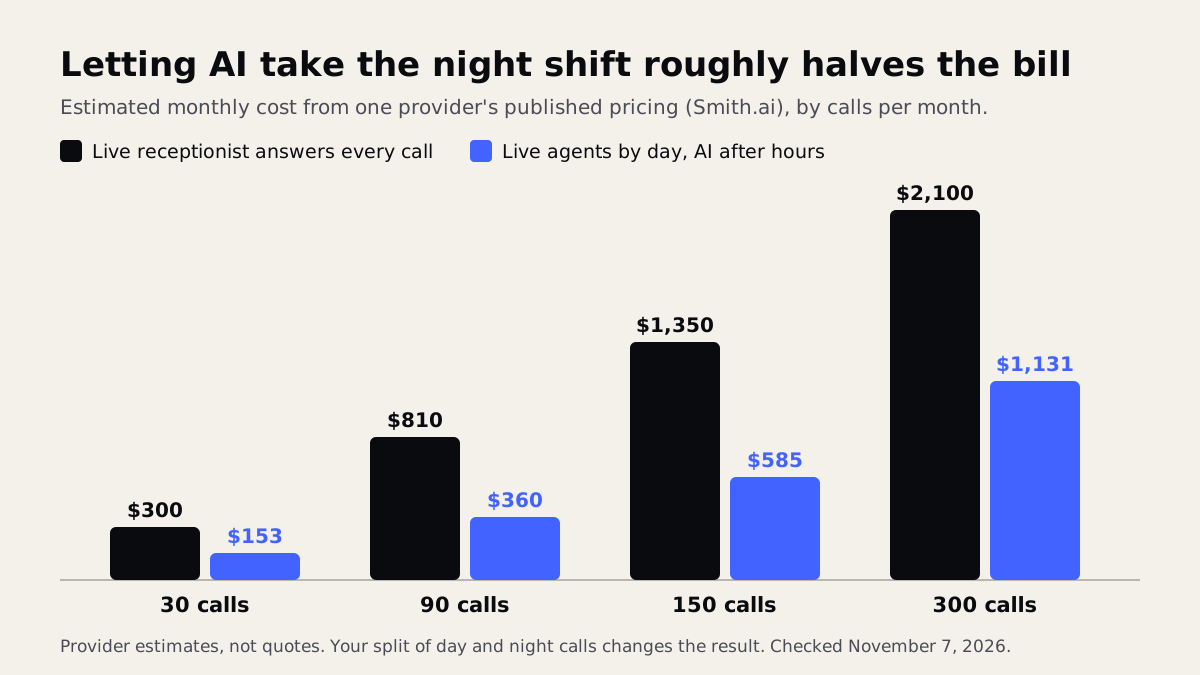
These are one vendor's own estimates, and the real number depends on how many of your calls arrive at night. Still, the pattern is clear: paying people to answer routine after-hours questions is the most expensive way to cover them.
When is a live answering service the better choice?
- Most night calls are real emergencies. A burst pipe, no heat in January, or a locked-out tenant. Callers in stress often want a calm human voice.
- Calls need judgment. Triage that depends on reading tone, or callers who are upset, confused or elderly.
- Your industry has strict intake rules. Medical and legal offices often need scripts handled exactly, and a human service may already be set up for that.
- You get few calls, and each one is worth a lot. If ten night calls a month are each a $2,000 job, the higher per-call price matters less.
When is an AI receptionist the better choice?
- Most night calls are routine. Hours, prices, service area, "can someone come Tuesday?" and requests for a callback.
- Calls come in bursts. AI can take several calls at once, so nobody hears a busy signal after a storm or a holiday weekend.
- You want the details in your systems. An AI receptionist can send each call summary straight into your calendar, CRM or a shared sheet, which makes the morning follow-up faster. Our guide to lead response time explains why that speed matters.
- Budget is tight. Per-call AI pricing is a fraction of live rates, as the table above shows.
Callers are more open to this than many owners expect. In a CallRail survey of 1,000 U.S. consumers, 52% said businesses that use AI assistants after hours give better service (CallRail, September 25, 2025). That is a vendor survey, so treat it as a signal, but it suggests an honest AI answer beats voicemail.
How do you set up a safe handoff to a human?
The handoff is what makes a hybrid work. Before you switch anything on, write down three lists:
- Always a human, right away: safety issues, gas or water emergencies, medical questions, angry customers and anyone who asks for a person.
- Human next morning: quotes for large jobs, billing disputes and complaints.
- AI can finish: hours, directions, booking a standard visit, taking a message.
Then decide who gets the urgent calls: an on-call technician's cell, the owner, or a live answering service as the backup layer. Ask each vendor in writing whether human transfer costs extra, how the transfer works if nobody picks up, and how fast you get the call summary. Smith.ai's own pages describe live-agent escalation differently in different places, which is a good reminder to get the terms confirmed before you sign.
One rule to remember: answering a customer who called you is different from contacting them first. If you also want automatic texts after a missed call, read the consent notes in our missed calls guide and check with a lawyer. We are not lawyers, and this is not legal advice.
What should you do this week?
- Count your after-hours calls. Pull the last 30 days from your phone provider. Note how many came after closing and on weekends.
- Sort them. Mark each as emergency, sales inquiry, routine question or spam. This tells you how much human coverage you really need.
- Price both. Use the minutes or calls you counted against two or three providers' published plans. Our breakdown of what an AI receptionist costs lists more options.
- Write the three handoff lists above and name who answers emergencies.
- Test before you trust. Call your own line at 9 p.m. with a routine question and a fake emergency, and check what reaches you.
If you would rather have this built for you, our AI receptionist service sets up the approved answers and the human handoff, and our lead capture and CRM automation puts every night call where your team sees it in the morning. To talk it through, book a free AI strategy call.
Frequently asked questions
How much does an after-hours answering service cost?
Published 2026 prices for live receptionist services start around $250 a month for 50 minutes at Ruby and $300 a month for 30 calls at Smith.ai. AI answering is cheaper, from a free 25-call tier to about $1.60 to $2 a call. Always confirm current prices with the provider.
Can an AI receptionist handle emergency calls?
It should recognize them and pass them to a person, not solve them. Set clear rules for what counts as an emergency, who gets the transfer, and what happens if nobody answers. For businesses where most night calls are emergencies, a live service may be the better fit.
Is a hybrid of AI and live answering worth it?
For many small businesses, yes. AI handles routine after-hours calls at a lower cost, and people handle urgent or sensitive ones. Smith.ai's own estimates show the hybrid costing roughly half of live agents on every call, though your mix of calls will change the result.
Sources
- Ruby pricing — www.ruby.com
- Ruby — www.ruby.com
- Smith.ai receptionist pricing — smith.ai
- Smith.ai AI Receptionist — smith.ai
- BLS — www.bls.gov
- Smith.ai hybrid pricing — smith.ai
- CallRail — www.callrail.com
Written and reviewed by the INTELVYRA team. Prices and figures were checked on the date above and can change. Always confirm current pricing with each provider.