AI News · 7 min read
What do Google's new AI Mode ads mean for a small business?
Short answerOn October 28, 2026, Google said it is launching "multiturn" ads in the U.S., which means a sponsored ad can appear in the follow-up questions of an AI Mode chat, not only the first search. Businesses that already run Search, Shopping or Performance Max campaigns are eligible automatically. The practical job this week is to check what your ads can now match, tighten your exclusions, and make sure every new click or call gets a fast reply.

What did Google announce on October 28?
Google made two announcements in one post on Wednesday, October 28, 2026. The first was geographic: ads in AI Mode, its conversational search experience, are scaling to ten more countries, including Australia, Canada, India and Singapore, with Brazil, Mexico and the United Kingdom planned for the fourth quarter (Google, October 28, 2026).
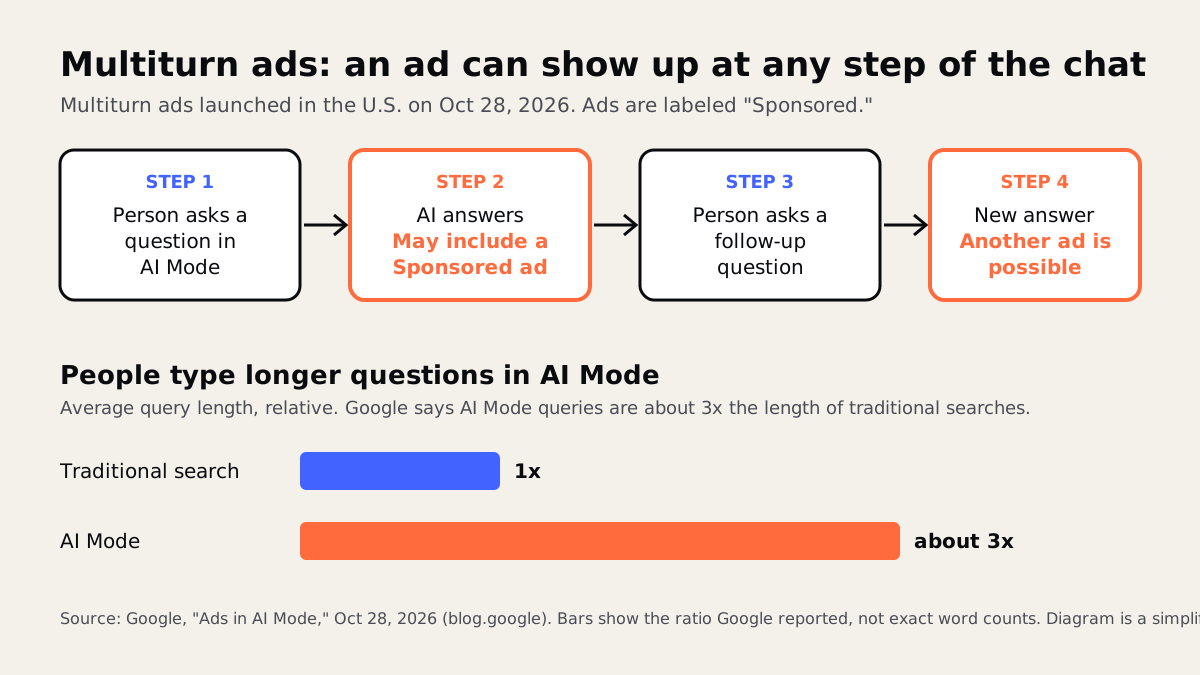
The second matters more to a US owner. Google is launching multiturn ads in the United States. In plain terms, a person can ask a follow-up question inside the same AI Mode conversation, and the new answer can carry an ad too. Google says these ads are labeled "Sponsored" (Search Engine Roundtable, October 28, 2026). Ads in AI Mode were already running in the US in English before this; what is new here is the chat-style, follow-up placement (Relevant Audience, October 29, 2026).
Why does a chattier search change anything?
Think of the old search results page as a highway billboard. Someone glances at it, decides, and drives on. AI Mode is closer to a mall concierge. The shopper asks a question, gets an answer, asks another, and the concierge occasionally says, "Here is a sponsored suggestion that fits." You are no longer bidding for one glance. You are showing up, possibly, in the middle of a conversation.
That conversation is also wordier. Google says AI Mode queries run about three times the length of traditional searches (Google, above). A person who used to type "plumber near me" may now write, "my water heater is leaking and it's Sunday, who can come today and what will it cost?" That is a buyer with a specific, urgent problem. It is also a question your ad was never written for.
Do you need a new campaign to appear in AI Mode?
According to Google's Ads Help page as summarized by Relevant Audience, no. Existing Search, Shopping and Performance Max campaigns are eligible through the normal auction, with no separate budget. Ads that use AI Max for Search, broad match, Shopping or Performance Max can match broader, exploratory questions as well as clear buying intent. Exact and phrase match keywords can only serve on queries with direct commercial intent (Relevant Audience, October 29, 2026).
Two other details from the same summary deserve a read. Advertisers cannot opt out of AI Mode separately from Search, because Google treats it as a core part of Search. And the main controls left are negative keywords and brand exclusions. If your account runs on broad match with automated bidding, your ads may already be eligible for these conversations, whether or not anyone on your team decided that.
What could go wrong for a small business?
Nothing dramatic, but three things deserve attention.
- Looser matching. Broader matching can put your ad in front of vaguer questions. If you pay per click, vague questions can burn budget on people who were only researching.
- Less visibility into the trigger. You control exclusions, not the conversation. Review your search terms report regularly and add negatives for services you do not offer or areas you do not cover.
- Reading too much into Google's numbers. Google reports that click-through rates were "already similar" for sponsored and organic product listings in AI Mode, based on its own US data from August 20 to September 3, 2026 (Google, above). That is product listings, measured by Google, over two weeks. It says little about a roofing company or a dental practice.
The common thread: the click is not the goal. A person who arrives from a chat-style answer often arrives already informed, and expects a fast, specific reply. If your form sits unread until tomorrow, or your phone goes to voicemail, the extra reach is wasted money. We cover why in our guide to lead response time.
What should you do this week?
- Ask whoever runs your ads (or log in yourself) whether you use broad match, AI Max or Performance Max. If yes, assume your ads can appear in AI Mode.
- Check your search terms report for the last 30 days and add negative keywords for anything you do not sell or serve.
- Rewrite one landing page to answer a long question. Lead with the plain answer: price range, service area, hours, how fast you can come. Pages that answer specific, conversational questions suit this format better than a generic "Contact us" page. Our web development team builds pages like this.
- Time your own response. Submit your own contact form tonight and see when the reply arrives. If it is hours, set up an instant acknowledgment and routing. This is what lead capture and CRM automation does.
- Cover the phone. If urgent searchers call instead of filling a form, an AI receptionist can answer after hours. See what an AI receptionist costs before you decide.
- Set a spending cap and review it in two weeks. Compare cost per real lead, not clicks.
If you track leads in a spreadsheet or inbox today, CRM automation for small business explains how to see which ads produce actual customers. And if you are weighing whether AI search should see your website at all, our note on the AI training opt-out is a useful companion.
What is still unknown?
Several things. Google has not said whether multiturn ads will reach the other markets, according to the coverage we read. We could not find independent data on how many people click these ads, or what they cost compared with normal search clicks, and Google's own figures cover one product category. Features also change quickly, so check Google's Ads Help documentation for the current rules before you change a budget. We will update this guide when better numbers appear.
The bottom line: you probably do not need to rebuild your advertising. You do need to make sure the traffic you are already paying for gets a quick, useful answer.
Frequently asked questions
What are multiturn ads in Google AI Mode?
They are ads that can appear in the answers to follow-up questions inside an AI Mode conversation, not only the first question. Google announced them for the U.S. on October 28, 2026, and says they are labeled "Sponsored."
Do I need a separate campaign for ads in AI Mode?
According to a summary of Google's Ads Help page by Relevant Audience, no. Existing Search, Shopping and Performance Max campaigns are eligible through the normal auction. Broad match, AI Max for Search and Performance Max can match broader questions. You cannot opt out of AI Mode on its own.
Is this only a problem if I pay for Google Ads?
No. If you only rely on free listings and referrals, nothing changes in your account. The change still affects you indirectly, because sponsored answers can sit next to the businesses people were going to find on their own. A fast, clear reply to every inquiry helps either way.
Sources
- Google — blog.google
- Search Engine Roundtable — www.seroundtable.com
- Relevant Audience — www.relevantaudience.com
Written and reviewed by the INTELVYRA team. Prices and figures were checked on the date above and can change. Always confirm current pricing with each provider.